Hands-on projects developed in 2024 thanks to Andrew Ng of DeepLearning.AI and his network of pioneer Generative AI partners: Google Cloud, OpenAI, Meta, HuggingFace, Amazon Web Services (AWS), Qualcomm, Mistral AI, MongoDB, Guardrails.AI, Qdrant, Weaviate, Haystack, Pinecone, LlamaIndex, crewAI, Intel, WhyLabs, Upstage AI and many other key players:
- Pretraining an LLM from data preparation to model configuration and assessment. Modifying existing models using Depth Upscaling to reduce training costs.
- Building and deploying a sophisticated AI agent capable of handling real-world customer support scenarios, fully serverless, and ready to scale with Amazon Bedrock. Integrating tools, code execution, and guardrails to manage agentic actions effectively with safeguards to prevent malicious prompts and unintended outputs. Project example: Building a customer service bot for a tea mug business that can handle tasks like answering queries, retrieving information, and processing orders. Connect your customer service agent to services like a CRM to get customer details and log support tickets in real time.
- Prompting and customizing LLM responses using Amazon Bedrock. Summarizing audio conversations by first transcribing an audio file and passing the transcription to an LLM. Deploying an event-driven audio summarizer that runs as new audio files are uploaded using a serverless architecture.
- Deploying AI models on edge devices like smartphones using their local compute power for faster and more secure inference. Explore model conversion by converting PyTorch/TensorFlow models for device compatibility, and quantize them to achieve performance gains while reducing model size. Device integration including runtime dependencies.
- Exploring Mistral 7B, Mixtral 8x7B, and Mixtral 8x22B (open source) and Small, Medium, and Large (commercial) to select the right model for a use case: Effective prompting techniques, function calling, JSON mode, and Retrieval Augmented Generation (RAG).
- Building an AirBnB recommendation system. Setting up a MongoDB database, a vector database, and a query database using text and image embeddings, building a retrieval augmented generation (RAG) aggregation pipeline applying pre- and post-filtering. Projections, boosting, and prompt compression.
- Hands-on multimodal prompting for tasks requiring advanced abstract and complex reasoning in practical applications like coding, vision tasks, and building workflows that balance intelligence and cost. Meta-prompting to optimize results.
- Using Canvas’ side-by-side workspace to brainstorm, draft, and refine text and code with ChatGPT. Using tools for debugging, targeted editing, and adding final polish. Building practical use cases: creating game apps, generating Python code from plot screenshots, and designing SQL databases from architecture images.
- Multimodal prompting with Llama for advanced image reasoning use cases such as understanding errors on a car dashboard, adding up the total of photographed restaurant receipts, grading written math homework. Function calling and custom tools with examples for web search and solving math equations.
- Adding AI validations (guardrails) to a RAG-powered customer service chatbot, implementing techniques to validate and verify inputs and outputs, building custom protections including personal identifiable information detection, focused response controls, building name detection pipeline, entity recognition, checking for hallucinations and prompt injections using natural language inference (NLI).
- Building faster and more relevant vector search for LLM applications.
- Designing and executing real-world applications of vector databases including hybrid and multilingual searches.
- Building applications including a retrieval augmented generation (RAG) app, a news summarization app, a chat agent with function calling and more.
- Building six applications powered by vector databases, including semantic search, retrieval augmented generation (RAG), and anomaly detection.
- Building smarter search and Retrieval Augmented Generation (RAG) applications for multimodal retrieval and generation using Weaviate vector databases, GPT-4 and Gemini Pro Vision.
- Agentic generative AI applications that allow large language models to work with your data in any format, using GPT-3.5 Turbo.
- Real world business use cases building advanced AI agentic workflows with Retrieval Augmented Generation (RAG). Practical applications include project planning, lead scoring, customer support analysis, and content creation at scale. Pipeline performance evaluation.
- Large Vision Language Models (LVLM). Multimodal RAG (MMRAG) system architecture. Embeddings. Preprocessing videos for MMRAG. Multimodal retrieval from vector stores. Multimodal RAG with Multimodal Langchain. Using OpenAI's Whisper and Large Language and Vision Assistant (LlaVA).
- Best practices for multimodal prompting and parameter control. Creating use cases with images. Developing use cases with videos i.e. “finding a needle in a haystack”. Integrating real-time data with function calling.
- Building an end-to-end workflow application for LLMs. Design and automation steps to tune an LLM for a specific task and deploy it as a callable API. LLMOps best practices. Responsible AI by outputting safety scores on sub-categories of harmful content. Hands-on projects to adapt a supervised tuning pipeline to train and deploy a custom LLM acting as a question-answering Python coding expert.
- Prompt engineering best practices for application development and building a custom chatbot.
- Exploring real-world scenarios to evaluate the safety and security of LLM applications, protecting against potential risks like hallucinations, jailbreaks, and data leakage.
- Creating demos of machine learning applications for image generation, captioning, and text summarization; sharing apps on Hugging Face Spaces.
- Performing text, audio, image, and multimodal tasks using Hugging Face transformers and sharing AI apps using Gradio and Hugging Face Spaces. Turning a small language model into a chatbot, summarizing documents, converting audio to text with Automatic Speech Recognition (ASR), and text to audio using Text to Speech (TTS). Performing image captioning and segmentation. Deployment options. Hands-on project: Deploying an image captioning API on Hugging Face Spaces.
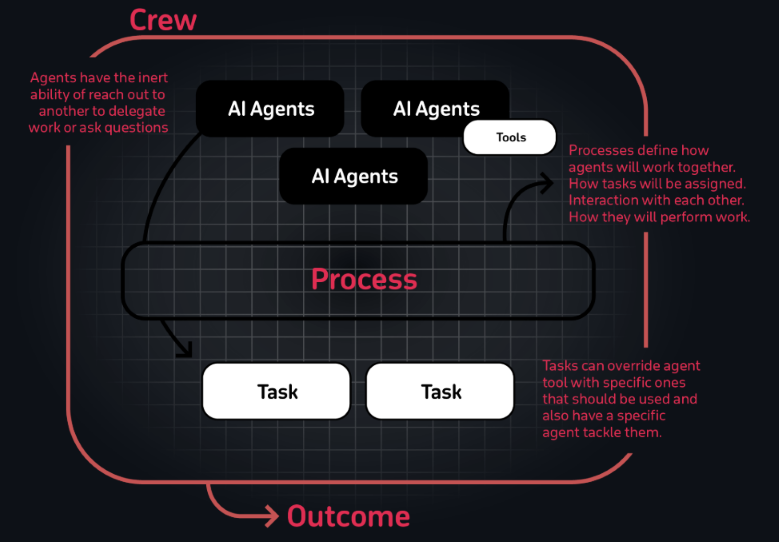
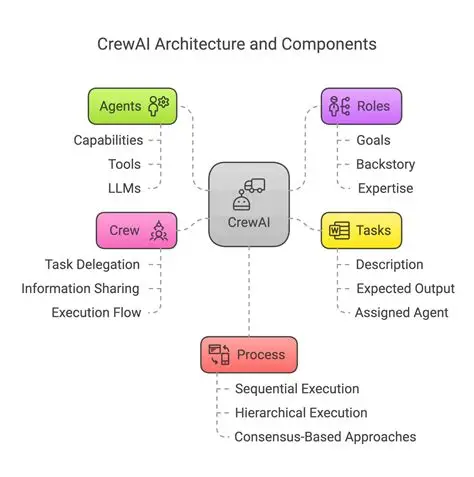
- Hands-on programming projects building a Multi-Agentic AI framework for orchestrating role-playing, autonomous AI agents that collaborate as a team to solve business problems such as: research and write an article; implement customer support automation; design a customer outreach campaign; automate event planning; collaborate for financial analysis; tailor job applications.
The "House of Analytics"* below illustrates the scope of my quantitative skills
(applied statistics & applied mathematics, the 4 pillars):
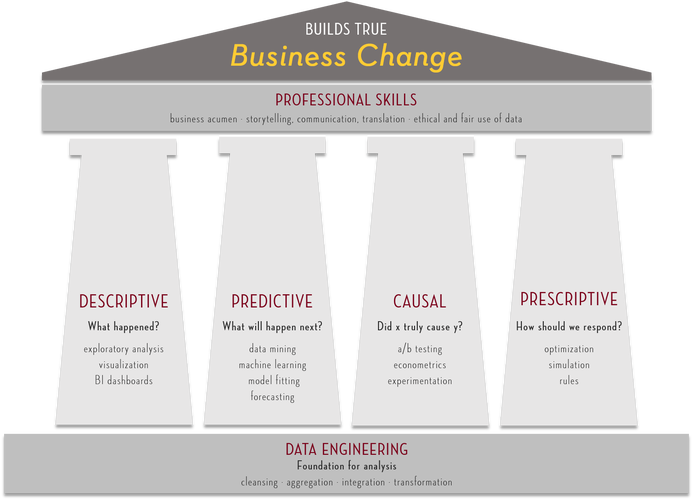
(source: Univ. of Minnesota)
Skills acquired since 2024 related to Generative AI include prompt engineering* for text, image, code, speech,
video, data generation/preparation/querying/augmentation, Gen-AI machine learning modeling,
Gen-AI driven interactive dashboarding and storytelling. LLMs for text classification and
sentiment detection, translation capabilities, code generation, text summarization and
question-answering
*Prompt engineering: Generative artificial intelligence (AI) systems (like ChatGPT) are designed to generate specific outputs
based on the quality of provided prompts or instructions received. Prompt engineering helps generative AI models better comprehend and respond to a wide
range of queries, from the simple to the highly technical. The basic rule is that good prompts equal good results.
Have a look at some of my advanced statistical analyses on
RPubs as well as Tableau for sample visualization projects.
How I got here
Passion for lifelong learning and innovation fuels my journey through the dynamic fields of
applied statistics and AI, always with a focus on leveraging these tools for tangible business
impact, so I actively engage with programs and training that connect business strategy to cutting-edge
research and technology. My curiosity extends to operations research, data science, econometrics, and
advanced quantitative methods—all vital for tackling complex business challenges.
My adventure began in 2016 with a transformative encounter: MIT's "The Analytics Edge" course on edX,
brillantly delivered by Professor Dimitris Bertsimas, Massachusetts Institute of Technology, Sloan
School of Management. This experience marked a pivotal moment as I realized the immense potential of
merging both the MBA mindset and quantitative/AI prowess within a single individual, without any
intermediaries. His approach ignited my dedication to combining Artificial Intelligence within business
strategy. Since then, I've been captivated by the relentless pursuit of knowledge in the dynamic landscape of Artificial
Intelligence—an interdisciplinary arena that constantly challenges and inspires. I've become somewhat
addicted to the exhilarating journey of upskilling, recognizing that in this ever-evolving field,
the learning never ceases. Join me on this exhilarating journey, and let's unlock the
potential of AI together!
Inspired by sharp minds, folks with a growth-mentality, and true competence (hint: work experience (i.e. a work certificate) does NOT
necessarily mean someone is competent), I chose two quotes from statisticians who endeavor to approach everything they do thoroughly - and do it right:
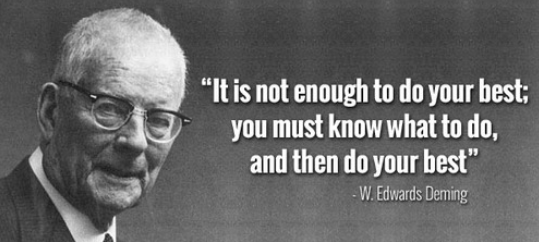
W. Edwards Deming , an American engineer, statistician, professor, author, lecturer, and management consultant, pointed out that:
To emphasize the importance of striving to really understand what you're doing,
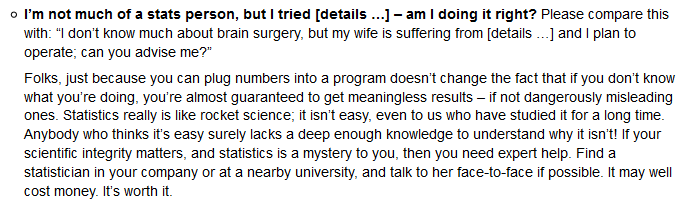
Prof. Russ Lenth – Department of Statistics and Actuarial Science, University of Iowa - puts it
nicely in this enlightening, yet quite provoking example: